A performance review should reflect the employee’s work—not the limits of a reviewer’s memory, and not the confidence of an AI-generated guess.
Review periods ask managers and employees to reconstruct months of performance from scattered information: objectives, project work, feedback, recognition, earlier results and their own observations.
That creates two familiar problems. Important contributions are forgotten, while recent events receive more weight than they deserve. Reviewers then spend valuable time searching for context before they can even begin writing.
AI can help—but automatically writing an entire appraisal introduces a different risk. A fluent draft can sound convincing even when the underlying evidence is incomplete.
EvalFlow takes a more deliberate approach.
Today, we are introducing Review Copilot, an evidence-backed conversational assistant built directly into the performance review experience. It helps reviewers find relevant information, understand what is available, develop their responses and refine their wording while keeping the final review firmly in human hands.
Review Copilot assists the reviewer. It does not become the reviewer.
[Suggested image: Review Copilot open beside an active performance review, showing the review and conversation together.]
A conversation beside the review
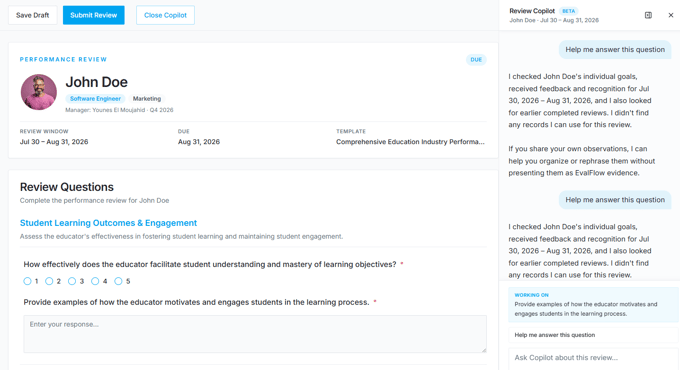
Review Copilot works inside the review the person is already completing.
The reviewer can ask natural questions such as:
- What information do we have for this review period?
- Help me answer this question.
- Summarize the previous review results.
- Make my response clearer and more constructive.
- Help me turn these observations into a measurable objective.
Copilot understands the review in progress: the employee, review period, template, sections, questions and the specific open-text response the reviewer is working on. Clicking into a written-response question brings that question into context, allowing the reviewer to request help without retyping it.
When useful wording is produced, one contextual action lets the reviewer place it into that answer. Nothing is inserted automatically. The reviewer can use it, revise it, undo it or ignore it entirely.
This creates a much more natural workflow than moving between a review form, employee records and a separate chatbot.
Give managers a clearer way to write fair reviews.
See how EvalFlow connects performance evidence, structured questions and human-controlled AI assistance.
Book a demoEvidence before prose
Review Copilot can examine relevant EvalFlow information the reviewer is already permitted to access, including, where available:
- individual objectives;
- OKRs and key results;
- authorized projects and assigned tasks;
- feedback received during the review period;
- recognition received during the review period; and
- earlier completed reviews of the same review type, used within strict relevance limits.
The active review window remains the boundary for current-period performance claims. Earlier records are clearly treated as historical context rather than quietly presented as evidence from the current period.
Copilot also understands the reviewer’s current draft responses and selected ratings. Those are treated as reviewer-provided context, not as independent proof about the employee. This distinction allows Copilot to improve wording without misrepresenting the reviewer’s own observations as verified EvalFlow evidence.
[Suggested image: A Copilot answer with compact “Evidence used” citations and a single “Use in answer” action.]
Grounded when evidence exists. Honest when it does not.
Review Copilot does not treat every available record as support for every conclusion.
A task marked “Not started,” for example, can establish the recorded status of that task. By itself, it does not prove poor performance, a missed deadline or a need for development. An earlier overall review score can support a factual historical trend, but it cannot explain an employee’s strengths, behaviors or the reason a score changed.
That evidence discipline matters.
Employee-specific factual claims must be connected to accepted evidence available to the reviewer. The interface shows the records actually used, not every record retrieved behind the scenes. Information that was checked but did not support the answer is kept separate.
When there is not enough information to answer a competency question responsibly, Copilot says what it checked, explains what is missing and invites the reviewer to add their own observations. It can then help organize or refine those observations without presenting them as system-verified evidence.
The result is a useful conversation—not a generic refusal and not a fabricated conclusion.
One assistant, three clear sources of context
Every useful response stays within one of three lanes:
- EvalFlow evidence — employee-specific facts supported by authorized records.
- Reviewer-provided context — drafts, selected ratings and observations supplied by the person completing the review.
- General guidance — writing support, review frameworks and coaching that make no unsupported claim about the employee.
Only accepted EvalFlow evidence is presented as evidence. Reviewer observations remain the reviewer’s observations. General guidance remains guidance.
This separation lets Copilot remain conversational without blurring where its conclusions came from.
Human judgment remains non-negotiable
Review Copilot deliberately does not:
- select or change ratings;
- answer several review questions automatically;
- submit a review;
- write directly to review records from the AI service;
- turn an overall score into unsupported strengths or weaknesses; or
- replace the reviewer’s accountability for accuracy, tone and employment decisions.
Instead, Copilot offers one focused recommendation at a time. The reviewer chooses whether it belongs in the answer, and every insertion continues through EvalFlow’s existing review and autosave experience.
AI-generated suggestions can still be incomplete or incorrect. Reviewers are reminded to verify evidence, dates and wording and not to rely on AI as the sole basis for ratings or employment decisions.
Privacy and permissions are part of the product—not an afterthought
Review Copilot never expands what someone can see in EvalFlow.
Access is tied to the person actually responsible for completing an eligible self-review or manager review. Evidence remains bounded by the organization, employee, review period and the caller’s existing module permissions.
Sensitive sources are excluded by design, including private one-on-one notes, performance improvement plans, compensation, leave and medical information, other reviewers’ drafts and hidden peer-reviewer identities.
If the reviewer cannot access a record through EvalFlow, Review Copilot cannot use it to answer the review.
Better review assistance without less human ownership
The goal of Review Copilot is not to produce more AI-written appraisals.
It is to help managers and employees:
- recover relevant context more quickly;
- reduce recency bias and reliance on memory;
- distinguish evidence from assumption;
- turn their own observations into clearer language;
- complete reviews with greater confidence; and
- remain fully responsible for the final assessment.
Employees deserve reviews that reflect what was actually recorded. Managers deserve help that saves time without making decisions for them. HR teams deserve a review process that improves consistency without sacrificing trust.
Review Copilot brings those principles together in one focused workspace.
Available now
Review Copilot is available within EvalFlow and can be enabled at the organization level. It supports English, French and Spanish and works directly inside eligible performance reviews.
The reviewer remains the author. EvalFlow simply makes the evidence easier to find and the review easier to complete.
See Review Copilot in action.
Give managers a clearer way to write fair reviews.
See how EvalFlow connects performance evidence, structured questions and human-controlled AI assistance.
Book a demo