How to increase performance review completion rates
Improve completion by removing the real blockers.
More reminders are rarely enough.
High completion comes from correct assignments, clear expectations, prepared managers, usable workflows and accountable follow-up. Diagnose the failure point before sending another reminder.
$6 per user/month · Standard onboarding included · No minimum seats
Completion is a system outcome
People finish reviews when the process is correct, clear and supported.
A missed deadline can mean the employee list is wrong, the reviewer does not understand the task, the form is too heavy, the manager is unprepared or the organization has not explained why the cycle matters.
Correct work first
Validate active employees, reporting lines, reviewer assignments, leave, recent hires and approved exclusions before launch.
Reduce task ambiguity
Every participant should know what they own, the due date, expected effort, visibility and where to get help.
Equip managers early
Train managers before the cycle so employee questions do not wait for HR and review quality does not collapse under deadline pressure.
Escalate with context
Use progress data to identify the specific manager, department or assignment blocker and resolve the cause.
Product evidence
See the real workflows your people will use.
These are current EvalFlow product views—not conceptual mockups. Your demonstration is configured around your roles, review structure and operating reality.
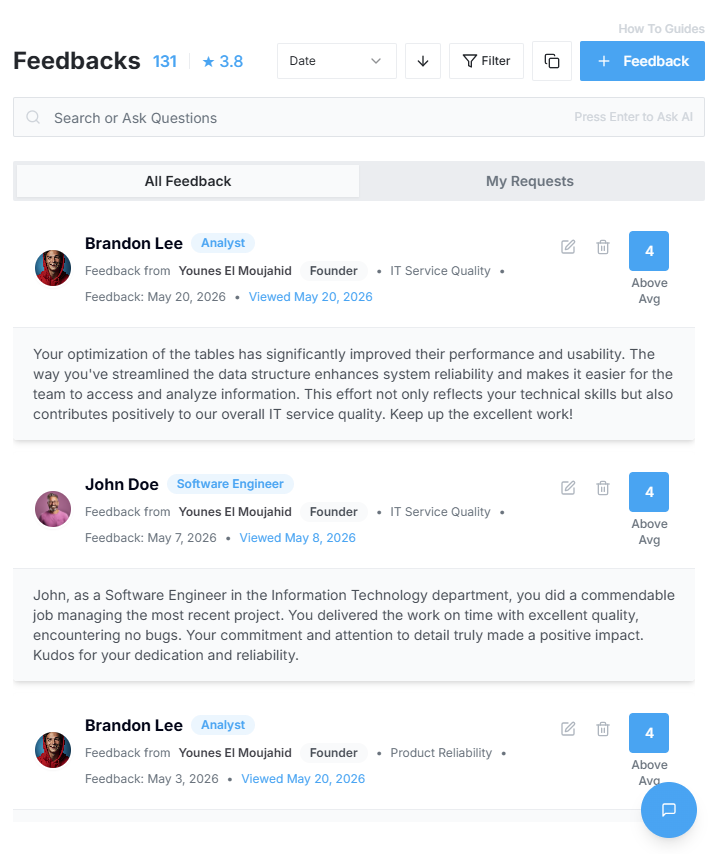
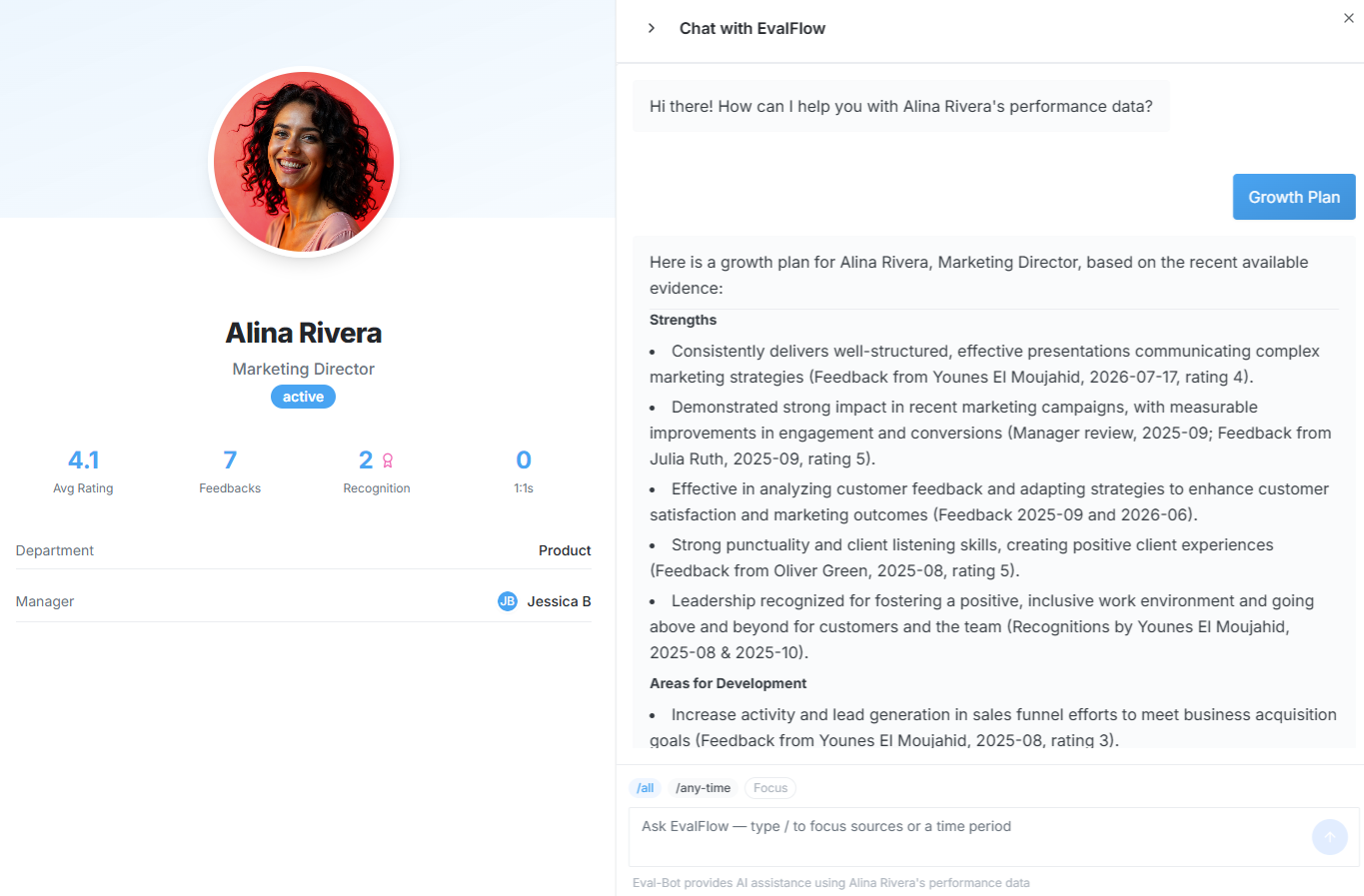
Real workflow
Use a four-step completion recovery loop.
Every step has a clear owner, visibility rule and next action. People remain responsible for consequential judgments and submissions.
1
Segment the incomplete work
Separate access failures, incorrect assignments, unopened tasks, active drafts, overdue conversations and approved exceptions.
2
Fix the cause
Correct data and permissions, simplify unclear instructions, answer policy questions and give managers targeted support.
3
Escalate to the owner
Route unresolved work through the manager and process-owner structure with a clear action and deadline.
4
Review the pattern
Compare completion by manager, department, task type and stage; carry the lesson into the next cycle design.
Completion should not mean pressured compliance
Make the work understandable and worth completing.
Employees participate more confidently when the purpose, questions, visibility and next step are clear. They should be able to report incorrect assignments or profile information without being asked to complete the wrong workflow first.
Clear value for every role
One connected process. Different responsibilities.
For process owners
Design the cycle, monitor progress and remove systemic blockers rather than sending undifferentiated reminders.
For managers
Explain expectations, create time for completion and resolve employee questions early.
For employees
Complete assigned work thoughtfully and report access, assignment or visibility concerns promptly.
Evaluate the operating fit
Treat completion as an operating problem—not an email problem.
The most effective intervention depends on the stage where work is stopping.
| Decision area | Typical standalone approach | EvalFlow approach |
|---|---|---|
| Never opened | Send the same reminder again | ✓Check invitation, access, manager communication and assignment accuracy |
| Draft stalled | Increase reminder frequency | ✓Clarify questions, expected evidence and available support |
| One team behind | Message every employee | ✓Work with the accountable manager and resolve the local blocker |
| Conversation overdue | Count the form as complete | ✓Track and support the manager-employee closeout |
| Recurring low completion | Accept the same cycle design | ✓Use stage data and participant feedback to redesign friction |
Implementation included
Your organization owns the process. EvalFlow carries the setup.
EvalFlow completes most initial configuration, validates the working setup with your designated process owners, trains administrators and managers on the approved workflow, and supports either an organization-wide or phased launch.
1
Align
Confirm the business purpose, owners, population, workflow, dates and visibility decisions.
2
Configure
EvalFlow prepares the initial users, structure, templates, permissions and workflow.
3
Validate
Process owners test the real setup by role and approve agreed corrections before release.
4
Prepare and launch
EvalFlow trains administrators and managers, supports communication and remains involved through launch.
Trust, connection and cost
Practical for users. Defensible for buyers.
Security by design
Tenant isolation is enforced at the PostgreSQL level with row-level security, authenticated access, role-based permissions, 2FA and server-side authorization.
Connected workforce data
Use supported HRIS connections, CSV or API planning to keep people, managers, departments and employment status aligned. Slack and Microsoft Teams connections support the workflow.
Predictable pricing
The standard plan is $6 per user/month or $5 per user/month billed annually. Confirm optional SSO/SAML and HRIS integration service scope during evaluation.
Frequently asked questions
What buyers and process owners ask.
What is a good performance review completion rate?
The practical target is complete, correct participation for every eligible assignment, with approved exceptions documented. A high percentage can still hide poor conversations or incorrect work.
Do automated reminders increase completion?
They help when participants already understand the task and can access it. Reminders do not solve incorrect assignments, unclear questions, manager avoidance or unresolved policy decisions.
What should HR check first when completion is low?
Check access, active employee data, reporting lines, participant assignments, task stage and whether managers communicated the process. Segment the problem before intervening.
Should employees complete an incorrectly assigned review?
No. Pause the affected workflow, correct the source and assignment, verify the fix and then ask the employee to proceed.
How does EvalFlow help with completion?
EvalFlow provides clear assigned work and process visibility while its team supports initial configuration, validation and manager preparation. The customer owns policy, escalation and internal accountability.
Continue evaluating
Evidence for the rest of your decision.
Bring your real process.
We’ll show you the working fit.
Use your roles, timing, workflow and buying requirements. We will demonstrate the experience, explain implementation responsibilities and answer the hard questions directly.
No setup fee · No minimum seats · Monthly option available